


Increase positioning accuracy while reducing development time
Save development time by using prebuilt GNSS receiver boards that feature Vanguard Technology™ with Universal Tracking Channels™ for reliable “all in view” tracking. These low-power consumption boards provide centimeter-level accuracy and sub-degree heading orientation for positioning applications.


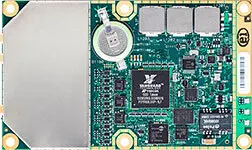
All-in-view dual-frequency tracking
So much functionality in such a small package. The ultra-compact B111 GNSS receiver board is capable of providing scalable positioning from sub-meter DGPS to sub-centimeter RTK positioning. The lightweight board offers 226 universal channels for reliable, “all-in-view” tracking of GPS, GLONASS, BeiDou, Galileo, QZSS and SBAS signals. The board’s flexible design—including its low power consumption, comprehensive communication interfaces and peripheral support—make it easy to integrate the B111 into any precise positioning application.
– Compact, dual-frequency receiver
– Low power consumption
– 226 Universal Tracking Channels for reliable “all-in-view” dual-frequency tracking
– High-performance RTK engine with a position-update rate of 100 Hz
– Diverse set of interfaces available through a single connector
– Support for SD card interfaces
– Quartz Lock Loop (QLL) for continuous operation under intense vibration and shock
– Scalable performance via software option authorization (OAF)
Full-constellation tracking and enhanced web capabilities in an ultra-compact package
Don’t be fooled by its small size. The B125 packs in future-proof tracking of GPS, GLONASS, Galileo and BeiDou signals with the ability to perform centimeter-level RTK positioning, all while being remotely accessed over ethernet.
The B125 GNSS receiver board is an ultra-compact positioning engine capable of providing scalable positioning, from sub-meter DGPS to sub-centimeter RTK. Low power consumption, comprehensive communication interfaces and peripheral support make the B125 extremely flexible and easy to integrate into any precise positioning application.
– Ultra-compact receiver board with futureproof GNSS tracking
– Low power consumption
– 226-channel Vanguard Technology™ with Universal Tracking Channels™, for reliable “all in view” tracking
– SD card interface support for quick and easy data collection
– Serial, USB, CAN and ethernet available through a single connector for data exchange
The most versatile OEM board for your most precise positioning needs
The B210 receiver board encompasses high-accuracy VHD heading determination and centimeter-level RTK positioning, all with low-power consumption, making this the most reliable and efficient OEM board for your needs.
You’ll find many outstanding features including low power consumption, futureproof GNSS tracking and comprehensive communication interfaces using Vanguard™ technology, ensuring you have the most precise positioning wherever you are.
Futureproof GNSS tracking of all constellations and signals (GPS, GLONASS, Galileo, Beidou, QZSS)
– VHD heading engine for fast initialization and high-precision heading output
– 226 Universal Tracking Channels™
– High-accuracy VHD heading determination
– Serial, USB, CAN, ethernet and external SD connectivity
– PS output and mark input for high-precision timing applications
Using UHF Radios for GNSS Base Station to GNSS Rover Communication
Topcon UHF (Ultra High Frequency) radio technology is a popular option for transmitting GNSS (Global Navigation Satellite System) data between a base station and a rover. This is because UHF radio signals can penetrate through trees and buildings, making it an ideal solution for surveying and mapping applications in challenging environments.
A Topcon GNSS base station is a stationary device that provides precise location data to a rover through satellite signals. The base station receives the satellite signals, corrects any errors in the data, and transmits the corrected data to the rover via UHF radio. The rover then uses this data to determine its precise location.
UHF radios for GNSS base station to GNSS rover communication are available in different configurations, including handheld, vehicle-mounted, and backpack systems. Handheld UHF radios are typically used for short-range communications, while vehicle-mounted or backpack systems are used for longer-range communications.
Extend your GNSS equipment reach with UHF radios
R4T-BT is an innovative, external radio designed to offer superior RTK performance with GNSS receivers. This solution features integrated batteries, Bluetooth® communication. It is an economical external UHF radio option for the HiPer GNSS receiver family product line.

If you already have a Topcon HiPer receiver but find yourself on a bigger job site or without a clear line-of-sight, you can extend the range from standard Bluetooth range to miles with this UHF radio. This radio also is compatible with most other GNSS receivers in the market.
SRL-35 -Powerful and portable
The SRL-35* high-power UHF radio provides the signal strength you need to cover the largest project sites. Pushing out 35 watts, the SRL-35 provides reliable signal strength in the most challenging environments. Built to IP67 standards, the light and portable radio features a weather-protected LCD display, integrated operator keyboard, and reinforced connectors.

Importance of UHF Radios in GNSS Communication
One of the key benefits of using Topcon UHF radios for GNSS data transmission is the ability to achieve real-time corrections. This means that the rover can receive corrected data in real-time, allowing it to make precise measurements in the field. Additionally, UHF radios can provide a reliable communication link, even in challenging environments, such as densely forested areas or urban environments with tall buildings.
Another advantage of UHF radios is their low cost compared to other GNSS data transmission technologies. This makes them a cost-effective option for many surveying and mapping applications. Additionally, UHF radios are easy to use and require minimal setup and maintenance, making them ideal for use by both professionals.


